Start with a decision the workshop can influence
A co-design workshop works best when residents can shape something specific. “Improve local services” is too broad for a first meeting. “Make it easier to find and use the neighborhood repair service” gives people a clearer task. Before inviting anyone, the service team should identify what can change, what cannot and who will decide what happens next. If hours or funding are fixed, say so. Residents can still help improve information, booking or the experience of arriving.
Write a short invitation in everyday language: what service is being discussed, why residents’ input matters, what will happen during the session and how the ideas will be used. Invite people who use the service, people who tried but could not use it and people likely to be affected by changes. Existing community groups may help reach participants, but an open invitation can make room for people outside those networks. Avoid treating one workshop as a representative vote.
Make participation possible before the meeting begins
Ask prospective participants what they need to take part. Depending on the setting, useful arrangements might include a step-free venue, clear directions, interpretation, large-print materials, a quiet space, a remote option or a way to contribute in writing. Choose a time with likely participants in mind, and explain any support available for travel or caring responsibilities. An accessible workshop begins with the invitation, not with a question asked at the door.
Send a simple agenda in advance and explain whether notes will be taken or ideas shared publicly. Let people know they may skip an activity or leave without explaining why. If staff hold authority over a service that participants rely on, acknowledge that imbalance: residents should not feel they must praise the service to be heard. A facilitator who is not responsible for defending existing procedures can help keep the discussion open.
Use a simple workshop plan
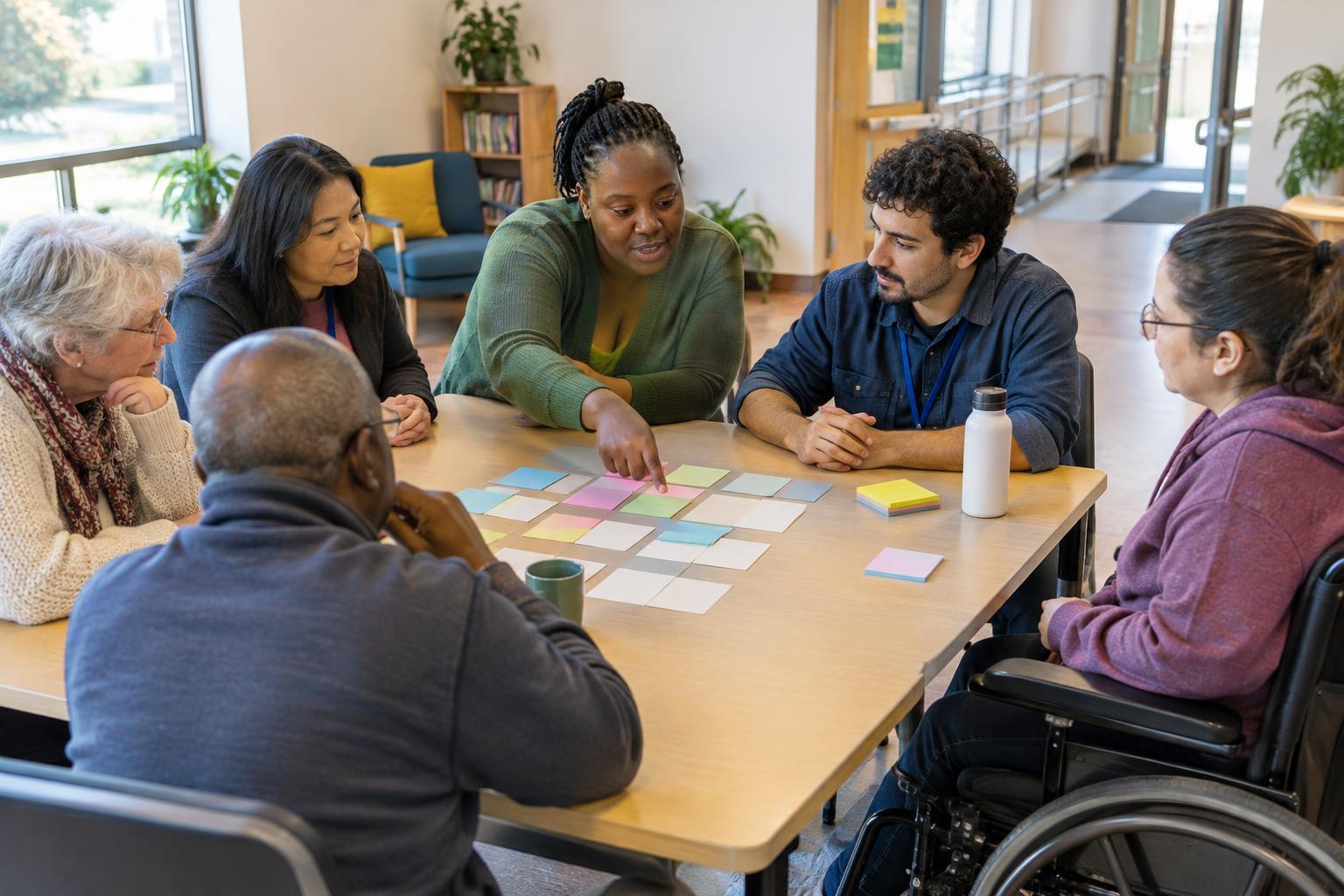
Allow time for three activities rather than trying to redesign the whole service at once. First, introduce the question and the boundaries for change. Ask participants to describe a recent attempt to use the service, focusing on what they needed to do rather than asking them to rate the service in general. A facilitator can map the steps on a wall or shared document: hearing about it, deciding whether it is suitable, making contact, using it and finding help afterward. Participants should be free to describe situations without sharing private details.
Next, look for points where the experience breaks down. Give everyone a chance to write or say what was confusing, costly, time-consuming or helpful. Group similar observations without erasing differences. For example, an online form may work well for some residents while excluding others. Ask, “Who would this change help, and who might it leave out?” before moving to ideas.
Finally, invite small groups to sketch one improvement each. A sketch might be a revised notice, a new way to ask for help or a clearer sequence of steps. The aim is not polished design; it is something people can discuss and test. Each group can explain which difficulty its idea addresses and what would need checking before it could be used.
Turn ideas into questions worth testing
It is tempting to end by voting for a favorite proposal. Instead, compare ideas against a few shared criteria: Does this address a difficulty residents identified? Could people with different access needs use it? Is it within the team’s ability to change? What might go wrong? These questions help distinguish an appealing idea from one ready for a small trial.
Imagine residents say a community tool-lending service is hard to discover. A group might suggest a printed guide available in familiar local places, while another suggests clearer information on the service’s website. Rather than declaring one approach the winner, the team could draft both and ask residents who missed the original service information whether either version helps. This is an illustrative example, not a claim that the same solution will suit every neighborhood.
Close the loop after people leave
Before the workshop ends, summarize what participants said in their own terms and check for misunderstandings. Explain who will review the ideas, when participants can expect an update and how they can correct the summary or stay involved. Do not promise implementation if the team has only committed to exploring options.
Afterward, send a brief, accessible account of the main difficulties raised, the ideas considered and the next action for each one: test, investigate, defer or decline. Give a reason when an idea cannot proceed. If a trial happens, invite feedback from people who attended and people who did not. A first workshop succeeds not because it produces a perfect design, but because residents can see how their contributions informed a decision and where they can influence the next one.